What this service covers
An active sub-slab system sized to the house in front of it: a full basement in Beaverdale, a walkout in Johnston, a split-foyer in Urbandale, or a slab villa in Altoona. Iowa Code chapter 136B requires certification through Iowa HHS for anyone who mitigates radon for a fee, and every install here is performed by a certified mitigation professional. The verification test that follows comes from someone outside the installer's firm, which is how Iowa separates the grade from the graded.
Typical pricing
$1,200-$2,500
Pricing varies by job specifics. Free phone or on-site quotes; fixed pricing once the technician has assessed the job.
What a fan on a pipe actually does under an Iowa basement
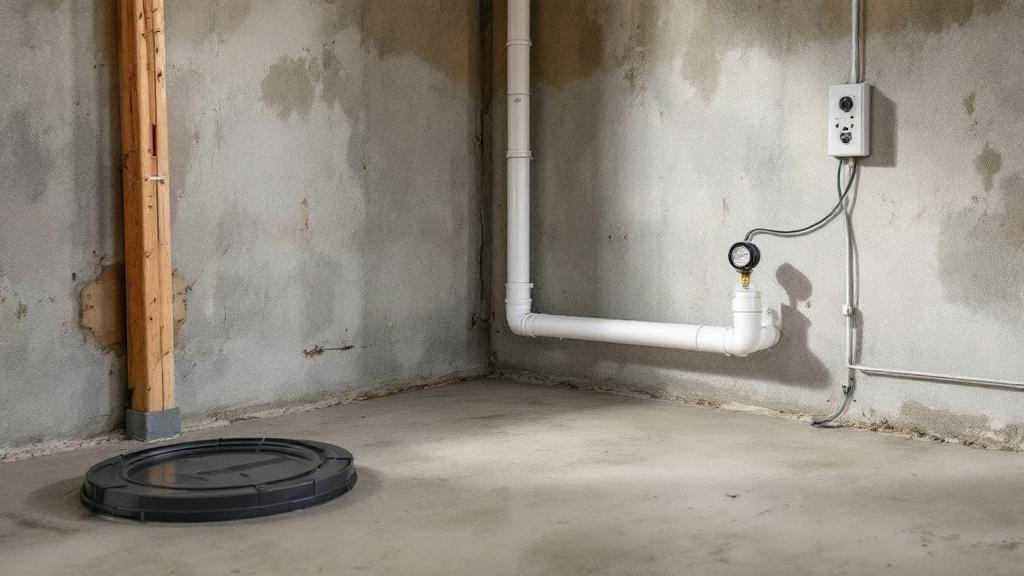
Soil gas moves toward low pressure, and in winter the lowest pressure around is the bottom of a heated Iowa house. The system reverses that arithmetic. A hole about the size of a dinner plate is cored through the slab, a few buckets of material are dug out to form a suction pit, and schedule-40 pipe carries a continuously running inline fan's suction to that pit. From then on the soil under the floor sits at lower pressure than the basement, so the gas follows the pipe and leaves above the roof instead of seeping through the concrete.
The EPA's Consumer's Guide to Radon Reduction credits this approach, active sub-slab suction, with reductions of 50 to 99 percent, and it is the default fix for the poured and block basements that sit under nearly every house from Indianola to Grimes. Sealing is the supporting act: the floor-wall joint, slab cracks, and the sump basket get closed so the fan spends its effort on soil rather than on basement air.
Where houses differ is underneath. The Des Moines lobe left dense glacial till across this metro, and tight till does not let suction travel far sideways. On larger slabs, floors poured in sections, and older houses with footing walls mid-slab, a quick diagnostic reading at a few test holes shows whether one suction point reaches everything or a second is honest to quote. That answer belongs in writing before anyone cores the floor, and our pricing by foundation type shows how each finding moves the number.
The Iowa certification system, and the retest rule that protects you
Iowa regulates radon work through Iowa Code chapter 136B and the Iowa HHS rules written under it (641 IAC chapters 43 and 44). Anyone who tests or mitigates for a fee must hold a credential from Iowa HHS, so the first question to ask any bidder is their certification, and the state's credentialing page is where to confirm the answer.
The rule worth teaching, because almost no homeowner has heard of it, is the one about who runs the test after the install. In Iowa, the post-mitigation measurement must be made by an independent measurement specialist who does not work for the installing firm, or by the homeowner. The installer does not grade their own work. That single requirement does quietly what a stack of warranty language tries to do loudly: the number that says your house is fixed comes from someone with no stake in the answer.
Plan for it from the start. The install is scheduled, the fan starts, the house returns to normal use, and then an independent certified measurement professional places a test. Keep that report with the house papers; the next buyer's inspector will ask for it, and it is the document that turns "there is a pipe in the basement" into "the system works." The independent retest FAQ covers how the handoff is arranged.
Designing around the housing the metro actually has
Basements are close to universal in central Iowa, which is one reason the state's numbers run so high: almost every house has a below-grade level in full contact with the soil, and most families use it. The design question is never whether there is an entry path, only which ones this house offers.
The 1970s through 1990s rings of Urbandale, Clive, and Pleasant Hill are heavy with ranches and split-foyers: block walls, slab-edge shrinkage cracks, a sump basket on perimeter drain tile, and a family room down where the readings are highest. These houses reward thorough sealing and usually take one suction point. Pre-war Des Moines, Valley Junction, and the blocks around Indianola's square bring stone and clay-tile foundations with floors poured in stages, where a second suction point earns its keep.
The growth towns flip the problem. Ankeny, Waukee, Grimes, and Norwalk are full of post-1995 poured basements, many with a builder's passive stub-up already roughed to the attic, so the fix is often a fan, a gauge, and a roof penetration rather than a core through the floor. Walkouts, the signature of Johnston and the Pleasant Hill bluffs, still pull gas through their three buried sides and mitigate like any basement.
What should be in the quote, and what you get at the end
Most central Iowa basement and slab installs land between $1,200 and $2,500; crawl spaces and combination foundations run higher, and adding a fan to a builder's stub-up runs lower. A fixed written price after someone has looked at the actual foundation is the only number worth comparing, and every quote here arrives that way.
Read a proposal for five things. The Iowa HHS certification of the person doing the work. The suction-point count and why, which should trace back to what the diagnostic readings showed. The fan location, in an attic, a garage with no living space above, or outdoors, with the discharge above the eave and away from windows, per the ANSI/AARST SGM-SF-2023 standard a correct install follows. The sealing scope, naming the floor-wall joint and the sump basket cover. And the plan for the independent verification test, including the fact that someone outside the installer's firm runs it.
The closeout package should hold the written warranty, the system description, the fan model, the manometer's marked start-up reading, and both test results, before and after. Keep all of it with the deed and the furnace manuals. See what mitigation costs here or start with the calculator.
Service area
Radon Mitigation Systems is available across Des Moines and central Iowa. Per-suburb pages: